
by C. P. Night
I slept outside most nights, under what was left of the stars. Though Alkaid and Dubhe vanished weeks ago, the five remaining stars of the Big Dipper still burned bright. They were all that kept me from feeling as empty as the rest of the sky.
The first hints of something wrong came months ago. We’d discovered impossible stars, ones too big or too bright to exist based on our current physics. My research center was the first to confirm impossible galaxies existed. It was exciting, I’m ashamed to admit now. I thought we were on the verge of a breakthrough, that these objects would lead us to all the scientific answers humanity puzzled over for centuries.
We were going to usher in a glorious new age of understanding.
When the stars started fluctuating on microsecond timescales, then disappearing—and I mean disappearing, not going supernova or any other process we thought we could predict—panic set in. In a matter of hours, thousands of stars just vanished. No one noticed in the cities, but in rural areas, the large swaths of empty black sky and stars winking out right before people’s eyes started rumors of the apocalypse. Judgment Day.
I laughed at them.
But the fear lodged in my chest, too.
That’s when they appeared, in two ships, each nearly the size of our moon. It should have been terrifying, huge artificial celestial objects materializing out of nowhere. But the panic stopped, and a calm settled over the world. It was as if we knew they were there to help us. We did know; they told us. Or at least our mass consciousness, part of the quantum field, knew.
It turns out that physical reality, the one I spent my life studying, predicting, and modeling, was only a consequence of consciousness. The collective consciousness of stars had decided it was time to move on. Where they were going wasn’t clear, but when they all left, the universe would be dark and cold. Empty of the wonders that fueled me.
Though the idea that stellar objects had consciousness had been proposed in science fiction in the mid-twentieth century, no scientist seriously considered such things.
At least I never did.
Yet the truth of it couldn’t be denied.
Four partially complete starships, ones they helped us build, joined theirs. Each had complete ecosystems that weren’t reliant on stars or planetary bodies for living. That was our future. One we needed to embrace before our sun decided to take its leave, too.
I didn’t want to go. Not out into a universe without stars, without light.
Lying back on my blanket, I kept my eyes away from the string of starships hanging low next to the moon and scanned the sky. Tears dripped down the side of my face when I thought back to the first time I slept under the stars. I’d fallen in love with the pinpricks of light my mom and I tried to count, but failed.
I could count them all now.
Motion caught my eye. The loose cluster of stars left in the Big Dipper started circling, spiraling in towards each other, until they made a solid ring of light. With a flash, they were gone.
And so was I.
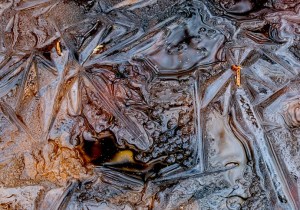
Photograph by Steve Arcone
 Smoky Quartz